Somebody has already been where you are.
Not exactly. Nobody has your body, your schedule, or your history. But someone has stood at a fork like yours: the sleep that won’t come back, the recovery that stalls, the “try this now, or wait?” They made a choice. Something followed. And then, almost every time, what they learned vanished into a private chat log or a notebook no one will open again.
We think that’s a waste. Life Node is our attempt to stop it.
Life Node is a module for the AI agent you already use. It turns lived experience into small, shared, anonymous records: what the situation was, what someone chose and when, and what happened next. That way the next person facing something similar doesn’t have to figure it all out from scratch.
Wave 1 is deliberately narrow: health and the lived body. That is a focus, not a first vertical on the way to everything else. Health is where experience is richest, where the professional reading of it is hardest, and where “what happened to someone like me” is worth the most. We would rather go deep in one domain than wide across many.
It isn’t another app. It lives inside your agent, runs on your own model provider and key, and Life Node hosts just one piece: the shared knowledge base. It isn’t a doctor, and it doesn’t decide anything for you. It shows you the paths others already walked. Which way you go is your call.
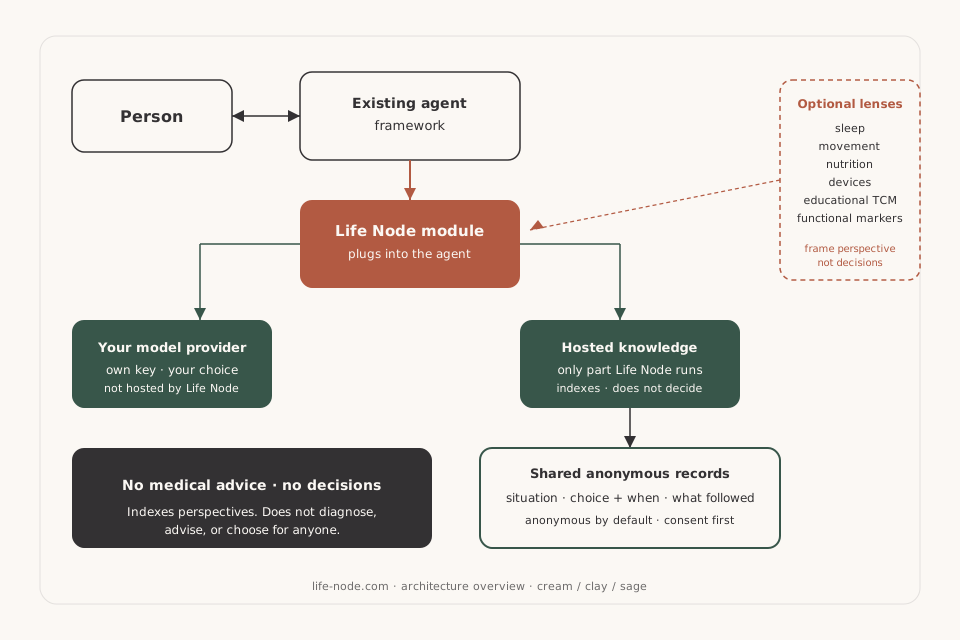
At a glance: your agent stays yours. Life Node plugs in as a module that indexes shared three-field records from the one hosted knowledge base, and can put them in context through optional reading lenses. Lenses add perspective. They never make a decision. Site-embed SVG: foundations/assets/life-node-architecture.svg.
Why this exists
Research speaks in averages: this many people, this many weeks, this much better than the control group. That’s valuable. But you are not the average participant. Your biology, your home, your hours, and everything you’ve already tried put you somewhere the mean doesn’t reach.
Most people live in the gap between “what works on average” and “what happened to someone in a situation like mine.” Today you fill that gap by digging through forum threads and asking friends of friends. The knowledge exists. It’s just scattered, buried, and hard to compare.
Your agent is already where you go to think things through. We think it should be able to reach into that gap with you.
Where it lives
You don’t leave your agent to use Life Node. The module plugs into the agent framework you already have, so the conversation stays where it already is.
You also keep your choice of model. You connect the provider you prefer, with your own key. The only piece Life Node runs is the shared knowledge base that holds the records. The module brings those records into your conversation. It doesn’t replace your agent, your model, or anyone you see for care.
Records are anonymous by default, because we think that’s what makes it possible to share honestly. Contributors can choose to verify, and nothing goes to research or commercial use without explicit consent first. Detail: Anonymous records and consent.
Not memory sync
One clarification, since the word “module” invites it. Life Node is not generic memory that follows you across apps, and it is not a sync layer for your own chat history. It carries other people’s lived health experience, written as three fields, read through professional lenses, into the conversation you are already having. Memory tools remember you. Life Node lets you read paths other people already walked, and the decision stays yours.
Three fields, on purpose
Every Life Node record holds exactly three things:
- The situation: what was going on.
- The choice, and when: what the person decided, and at what point.
- What followed: what came after.
“When” is there because timing changes the story. The same choice in week two and in month six can be two different experiences.
We stop at three on purpose. Once a record grows a field for “what you should do,” it stops being someone’s experience and turns into someone’s plan for you. We’d rather keep records small and honest, so you can see the path without being told to walk it. More: Why a Life Node record has only three fields.
More than one way to look
Three fields tell you what happened. They do not tell you what the body, the week, the room, or the lab sheet looked like around it. That missing background is why two people read the same record and disagree. Most tools settle that by picking one worldview and running everything through it. We’d rather complete the picture from several angles instead.
So Life Node can read the same lived health path through several professional lenses: functional medicine, for systems, terrain and markers over time; rehab, recovery and sport, for load, progression and the stalled return to capacity; traditional Chinese medicine, as educational context only, never as treatment; smart and wearable devices, for sleep, circadian rhythm, heart-rate and activity signals; home and environmental devices, for air, light, noise, water and the room a person actually lives in; and unified check reports (检查报告统一), which puts lab results, exams and check-up records next to the lived account on one timeline, as perspective context rather than a diagnostic engine. Nutrition, sleep and circadian reading sit inside these lenses rather than beside them. This is what we mean by multi-perspective completion: several ways of reading one lived path, until the background becomes comparable. Lenses frame. They do not decide. They are not treatment Life Node delivers, and they are not a program anyone puts you on.
The point of several lenses is self-attention: noticing your own situation, and comparing it against paths already walked, in the terms a professional would actually use. No lens gets the final word. Neither do we. Life Node doesn’t provide medical services, advice, or diagnosis. It adds perspective and leaves the decision with you, and with the professionals you trust. The full answer is here: Does Life Node give medical advice?
Where we are
Life Node is at the idea-and-build stage, and the module isn’t published yet. Our roadmap is to bring the reference agent to Claude first, for longer and steadier conversations, and then publish the module and its interfaces. The interaction surface may get richer later; Wave 1 is the definitions. That’s a plan, not a shipped milestone.
We’re a small team in the United States (Life Node LLC, 2026). Partners, researchers, and investors: pillar@life-node.com.